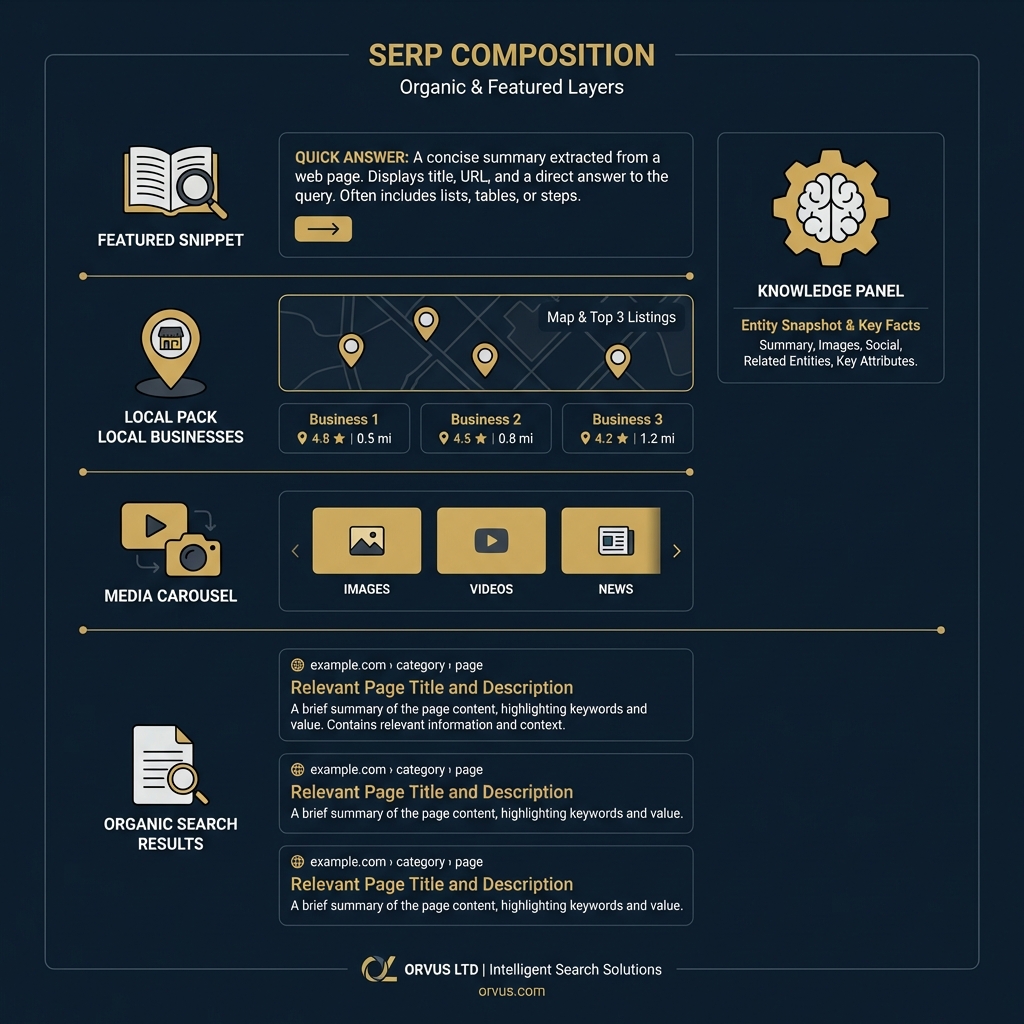
What is a SERP? How serp google builds the results page
A SERP is the full page a search engine returns for a user query, and it can contain organic results, paid ads, featured snippets, knowledge panels, local packs, and multimedia carousels. The exact makeup depends on query intent and the signals Google uses to match answers to that intent, so one query can look very different from another Search appearance - Overview
When we say serp google in this guide we mean the page-level experience that users see after submitting a query. That includes traditional blue links, but also blocks that directly answer questions or highlight businesses and media. Google continues to experiment with generative presentations, yet those experiments still draw on the same index and signal set that determine eligibility for features How Google Search works
Request a compact consultation to map your search architecture
Run a quick audit now: pick one commercial query and check the Search Console impressions row and the live SERP to see which features appear.
For practical teams, the distinction matters because different parts of the SERP require different investments. Organic visibility and paid positions are measured and optimized differently, and specialized features often need extra formatting, markup, or public data to trigger.
Quick definition
At its simplest, a SERP is the page returned in response to a query. It is not only organic links; it is the whole presentation layer a search engine shows to a user, including any of the specialized modules that may appear for that query Guide: What are SERP features and how to optimize for them
Which elements can appear on a SERP
Common elements include organic listings, paid ads, featured snippets that answer questions, knowledge panels that summarize entities, local packs for nearby businesses, and image or video carousels. Each of these elements has its own trigger signals and visibility pattern Search appearance - Overview Search Engine Land also maintains a practical guide to common SERP elements and optimization patterns Search Engine Land: SERP features guide

Key SERP features and what triggers them
Below are the feature types most teams track and a one-line summary of the main trigger or requirement.
- Featured snippets and answer boxes: Often triggered by concise, authoritative answers and clear headings on a page; structuring content as question and answer increases eligibility About featured snippets and other SERP features
- Knowledge panels: Drawn from entity-level data and public knowledge sources; strong signals include consistent public citations and structured entity data
- Local pack: Requires accurate local business listings and consistent citations, plus relevance to the query’s local intent Guide: What are SERP features and how to optimize for them
- Image and video carousels: Triggered when visual or multimedia answers match intent; metadata, captions, and hosting pages matter for indexing
- Paid search blocks: Appear when advertisers bid on keywords; they sit apart from organic placements and have their own measurement and reporting
Note that prevalence and click patterns for each feature differ by vertical and query intent, so the same tactic has different returns across queries and industries Guide: What are SERP features and how to optimize for them (see a comprehensive guide at Backlinko Backlinko: SERP features)
How Google builds a SERP: indexing, ranking, and generative experiments
Google builds search results by crawling and indexing web content, then applying ranking algorithms that weigh relevance and quality signals to select and order candidates for a query How Google Search works
Indexing captures page content and structured markup so the engine can match documents to queries. Quality signals such as content usefulness, page speed, and link context influence which pages rank and whether a page is eligible for specific SERP features Search appearance - Overview
Google uses its index plus relevance and quality signals, and it overlays specialized features based on intent and structured data; generative presentations change how results are shown but still rely on the same underlying index and signals.
Generative or AI-driven SERP elements change the way answers are presented for some queries, but they still rely on the underlying indexed documents and the same relevance signals. That means improving indexability and content quality continues to matter even as result presentation evolves How Google Search works. For context on AI-driven result formats see Semrush's overview of AI Overviews Semrush: AI Overview
What SEO is and how it maps to SERP visibility
SEO is the ongoing practice of improving a site’s technical setup, content architecture, and authority signals to increase visibility in organic parts of the SERP. Technical work, content structure, and link context work together to affect organic placement and feature eligibility What is SEO? A concise guide to technical and content SEO
Technical SEO ensures indexability, correct structured data, and acceptable loading performance, which are often prerequisites for being surfaced in answer features. Content architecture organizes pages so intent-aligned queries find concise answers and so the engine can extract those answers for snippets About featured snippets and other SERP features
Technical SEO and content architecture

Technical SEO covers crawlability, sitemaps, canonicalization, and structured data. Getting these basics right is necessary before investing heavily in feature-specific formats like Q&A or how-to blocks.
Content architecture means mapping content to intent, using concise headings, and formatting answers so they can be excerpted for snippets and similar features What is SEO? A concise guide to technical and content SEO
Authority signals and link context
Authority signals such as links, mentions, and citations help pages compete for organic visibility, especially for commercial or competitive queries. Those signals also feed entity understanding that underpins knowledge panels.
Authority is not only backlinks; public consistency of business data and citations affects local signals and knowledge graph signals alike Guide: What are SERP features and how to optimize for them
A practical framework to optimize for SERP features
Start with an audit, map opportunities by intent and value, implement technical and content fixes, and measure changes with Search Console and analytics. This simple loop keeps work focused on downstream outcomes rather than impressions alone Search appearance - Overview
Step 1: Audit search architecture and feature presence using Search Console and manual SERP checks. Capture which queries show which features and where your pages appear in organic listings How Google Search works

Step 2: Prioritize by intent and conversion relevance. Not every feature is worth the same investment. Map queries to funnel stage and expected downstream value before you build feature-specific content.
Step 3: Implement three tactical areas. Fix technical blockers for indexability and speed, format content as concise answers or how-to blocks where relevant, and add structured data or citation updates to improve eligibility for target features About featured snippets and other SERP features
Step 4: Iterate with experiments and short measurement cycles, tracking impressions and clicks by feature and correlating to conversions in analytics to see which features move business outcomes Search Console & attribution: measuring search impact on conversions
Feature-by-feature tactics: snippets, knowledge panels, local packs, and media carousels
Featured snippets and answer boxes often reward concise, well-structured answers placed near strong headings, lists, or tables. Use clear H2/H3 questions and a short paragraph or list that directly answers the question About featured snippets and other SERP features
Knowledge panels are entity-level displays that benefit from consistent public data and authoritative citations. For businesses, maintaining accurate public profiles and structured entity markup can help the engine tie content to a single entity.
Local pack and citation hygiene
Local pack eligibility depends on relevance, distance, and prominence. Keeping Google Business Profile details current, consistent citations across directories, and accurate opening hours are basic hygiene items that support local visibility Guide: What are SERP features and how to optimize for them
Avoid inconsistent NAP data and outdated listings; these can fragment local signals and reduce the likelihood of appearing in a local pack.
Media and rich results
Image and video carousels reward media with correct metadata, captioning, descriptive host pages, and appropriate schema like video schema for videos. Host pages should provide context and structured fields so the search engine can index the media reliably Guide: What are SERP features and how to optimize for them
Paid blocks and shopping results require separate measurement and bidding strategies; they can complement organic visibility but are not substitutes for technical and content work.
Measuring SERP impact and tying search to revenue
Measurement begins with Search Console to capture impressions, clicks, and feature appearance for queries you care about. Use the search appearance and query reports as baselines before you run experiments Search appearance - Overview
Correlate those baselines to downstream conversions in analytics to understand which features and queries lead to real value. This step requires linking Search Console rows to page-level analytics and conversion events Search Console & attribution: measuring search impact on conversions
Record baseline Search Console rows and analytics for target queries
Capture the date and report name
Attribution has limits. When answer features reduce clicks, model value by measuring downstream assisted conversions, visits to related pages, and branded navigation uplift as pragmatic proxies rather than relying on a single last-click view Search Console & attribution: measuring search impact on conversions
Combine paid reporting with organic feature tracking to get a fuller view of the SERP. Paid impressions, click-throughs, and conversion rates belong in the same decision framework as organic feature impressions so you can weigh cost against marginal value How Google Search works
Decision criteria: which SERP features should your team prioritize?
Match features to business objectives. Choose features that align with conversion goals rather than those that only drive raw impressions Guide: What are SERP features and how to optimize for them
Weigh traffic and conversion potential against implementation cost and your team’s bandwidth. Prioritize features with a plausible path to measurable downstream value and de-prioritize low-relevance features.
When bandwidth is limited, focus on quick wins that improve indexability, speed, and core content format for high-intent queries before investing in extensive feature builds.
Common mistakes and how to avoid them
Chasing features without measurement wastes time. Without baselines and conversion mapping, feature work can increase impressions but not business outcomes Search Console & attribution: measuring search impact on conversions
Adding schema alone rarely wins features if the underlying content is thin or the site has technical blockers. Schema is necessary in many cases but only effective when built on strong content and indexability About featured snippets and other SERP features
Ignoring citation hygiene for local businesses is a common error; inconsistent listings fragment local signals and can reduce eligibility for local packs Guide: What are SERP features and how to optimize for them
Practical scenarios: ecommerce and service business examples
Ecommerce sites often prioritize product schema, structured metadata, and concise answer content for comparison and buying-intent queries. That combination helps product pages appear in rich snippets and shopping experiences Guide: What are SERP features and how to optimize for them
Service businesses tend to focus on Google Business Profile accuracy, local citation hygiene, and how-to or FAQ content that answers local intent queries. These elements support local pack presence and answer features for service queries.
Measurement differs by vertical. Ecommerce teams can often connect product page clicks directly to transactions, while service businesses may need lead tracking and assisted conversion models to value visibility properly.
Quick audit checklist you can run this week
Top quick checks: confirm indexability for priority pages, review Search Console rows for feature impressions, measure page speed for key landing pages, verify essential schema is present, and check Google Business Profile status for local businesses Search appearance - Overview
Record screenshots of live SERPs for representative queries, export Search Console rows, and note which queries show which features. Use that evidence to prioritize quick wins and medium-term projects.
Implementation roadmap: a 30 to 90 day approach
Phase 1 (30 days): run the audit, capture Search Console baselines, and fix critical technical blockers such as indexability and canonical issues How Google Search works
Phase 2 (60 days): implement prioritized content and structured data for the highest-value queries, then run small experiments to validate feature eligibility and conversion impact About featured snippets and other SERP features
Phase 3 (90 days): scale experiments that show positive downstream signals, refine measurement dashboards, and hand off routine reporting and alerts to stakeholders so the team can sustain improvements.
When to bring a strategic growth partner
Consider embedded help when channels are stalled, measurement does not tie to revenue, or repeated tactical work keeps failing due to bandwidth or systems gaps. A partner can help re-architect search, set up measurement, and build small automations to reduce recurring work Search appearance - Overview
Orvus Limited acts as a systems builder and strategic reference for scalable search architecture and measurement, focusing on search architecture, AI tooling, and automation without promising outcomes. A partner should help you define priorities, run experiments, and hand over dashboards and runbooks.
Conclusion: next steps and a compact reading list
First actions: run the quick audit, prioritize features by conversion relevance, and set up baseline measurement in Search Console and analytics so you can iterate from data rather than assumptions Search appearance - Overview
Further reading: start with the Search Central overview and the featured snippets guidance, then review measurement resources on attribution to understand limits and practical approaches About featured snippets and other SERP features. Also see our blog for related posts Our blog
A SERP is the page shown for a query, including organic listings, paid ads, and specialized features. SEO is the ongoing work to improve a site’s technical setup, content architecture, and authority so it performs better in the organic parts of that page.
Not always. Structured data helps signal eligibility for some features, but content quality, indexability, and public citations are often equally or more important.
Measure impressions and clicks in Search Console, then map those rows to downstream conversions in analytics and use assisted conversion or branded uplift as pragmatic proxies when direct clicks fall.
References
- https://developers.google.com/search/docs/appearance/overview
- https://developers.google.com/search/blog/2024/12/how-google-search-works
- https://searchengineland.com/guide/what-are-serp-features
- https://searchengineland.com/guide/serp-features
- https://backlinko.com/hub/seo/serp-features
- https://developers.google.com/search/docs/appearance/featured-snippets
- https://www.semrush.com/kb/1435-ai-overview
- https://moz.com/learn/seo/what-is-seo
- https://www.statista.com/study/serp-attribution-search-console-conversions-2024
- https://orvus.net/services
- https://orvus.net/about
- https://orvus.net/category/useful-knowledge